


The Network of Ideas
John Rawls, the colossus of liberalism, died over the weekend.
News of his passing reminded me of something buried in a box in my back-room drawer, which I just fished out. Click for a small version or a full-sized image (about 560k).


When I was a grad student at Princeton, someone told me that (just like most libraries before computers) the books in Firestone library used to have a pocket inside the cover where the book’s borrowing record was kept on a removable card. When someone wanted the book from the library, the card would be removed and stamped with the date. Again, quite standard. The little twist was that faculty and students had a little stamp to mark their own name on the card, or (either earlier, or instead) they actually signed the card when they borrowed the book.
By the time I got there, the computer catalog and University ID cards had replaced this system. The books have barcodes and the computer catalog keeps a record of everyone’s borrowing. But Firestone has a huge number of volumes, so the library staff couldn’t simply stick the new barcodes in every single book at once. Instead, they did it piecemeal. If an old book was borrowed under the new system for the first time, a barcode sticker would be affixed to its inside cover. The old card, and the borrowing record it held, was thrown away.
Very occasionally, then, one would come across a book or journal that had been acquired by the library under the old system, had been borrowed a few times, but then lost popularity and just sat in the stacks. Inside the back pouch would be the old library card, with its list of dates, stamps and signatures on it.
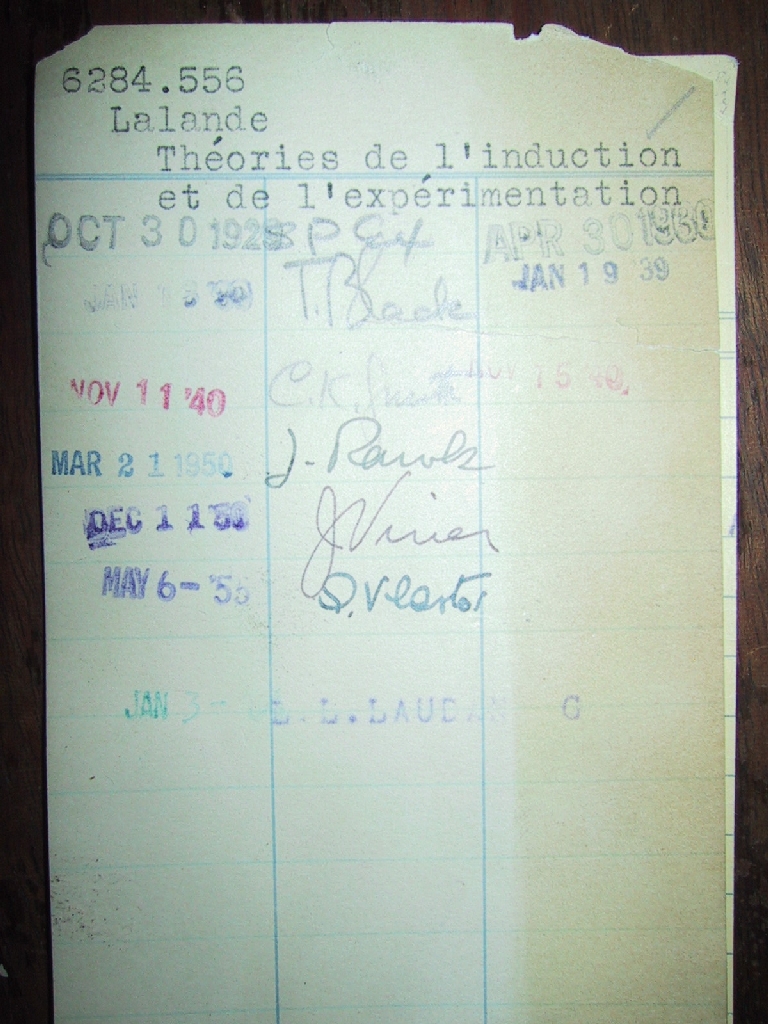
A disused Firestone Library card.
Princeton has been home to some famous academics. Look at this card, for example, which I found inside a book one slow day in Firestone. There is John Rawls, on March 21st 1950. There, underneath him, is Jacob Viner, the economist. And there (I’m pretty sure), is Gregory Vlastos, the ancient philosopher and ethicist. (The stamp at the bottom belongs to Larry Laudan, the philosopher of science.)
I’m not an autograph hunter, or celebrity-spotter, but I find it irresistable that the old books in Princeton’s library bore a record of the people who picked them up. The image I have (borrowing from my brilliant colleague Ron Breiger) is of the duality of books and readers: readers are partly defined by the books they have read, and books, in their own way, are networked into literatures through their common readers. In Firestone library, tucked inside some old books, is the ghostly outline of a once-living social system of people and their ideas.
In some ways, the Internet—- and especially things like blogs, God help us—- bring that outline into sharper focus. Instead of someone’s autograph inside a book, we can have a whole record of their thoughts on a topic. And instead of just glimpse of the interconnection and mutual constitution of individuals and ideas, we can have a real, dynamic map of the network. At least, that’s the promise of tools like Blogdex, Organica, and the The Blogging Ecosystem. But the hint of all this is there in that library card, which is why I took it with me out of Firestone when I found it.